
Most companies do not have a website problem.
They have a middleman problem.
A founder hears the same objection on three sales calls. Marketing sees a PPC angle starting to work. Sales needs a sharper page for a specific audience. A new offer is ready, but the website still says the old thing.
Everyone knows the page should change.
Then it enters the queue.
The designer needs to touch the layout. The developer needs to adjust the theme. The agency needs a brief. Someone needs to check the WordPress plugin stack. Someone else worries the page will break the brand.
A simple test becomes a small project.
By the time the page is live, the campaign has already moved on.
That is how growth slows down. Not because the team has no ideas. Because the website cannot move at the speed of those ideas.
This matters because the website is no longer a brochure. HubSpot’s 2025 Website Marketing Report found that 60% of website marketers listed traffic growth as a top priority, and 34% listed conversion-rate improvement.1HubSpot, Website Marketing Report 2025 Webflow’s 2025 State of the Website report found that 91% of marketing leaders say the website drives more revenue than any other marketing channel.2Webflow, 2025 State of the Website
So the website is expected to create traffic, conversion, and revenue.
But the workflow around it often still moves like a redesign project.
That is the gap.
Main layer
WordPress is not the enemy
The usual answer is too extreme: rebuild the website.
Sometimes that is the right move. Most of the time, it is not where I would start.
A WordPress site can be doing important work already. It carries the homepage, brand story, legal pages, trust pages, blog, CMS workflows, internal links, and years of organic SEO performance. People know how to use it. Google knows it. The company has built authority around it.
That authority matters.
Google recommends choosing canonical URLs for duplicate or very similar pages when you want to consolidate signals, simplify tracking, and avoid wasting crawl time.3Google Search Central, canonicalization documentation If a company has spent years building authority on one domain, the answer is not to scatter new pages across disconnected places.
Throwing the main site away because landing pages are hard to change is usually wasteful.
The problem is not that the old system is useless. The problem is that the old system was not built for weekly growth experiments.
The HTTP Archive Web Almanac describes this in a technical way: WordPress is durable and flexible, but real-world performance depends heavily on implementation, themes, plugins, page builders, and operational complexity.4HTTP Archive, Web Almanac CMS chapter In plain English: the admin bar is not the full story. The setup and workflow around it matter.
So we should stop asking one website to do every job at one speed.
Keep the system that creates trust and authority.
Add the layer that creates speed.
Growth layer
The two-layer website framework
We split the website into two jobs.
The first job is trust.
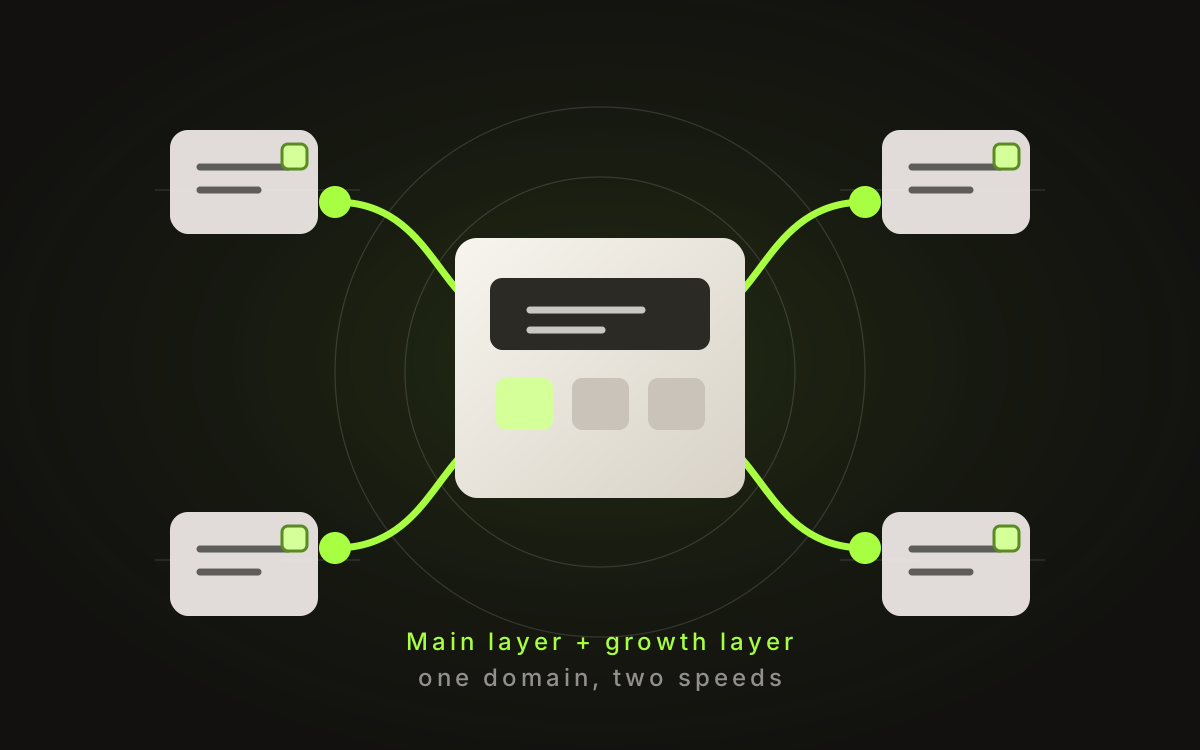
That is the main website layer: your existing website. It holds the homepage, about page, core services, legal pages, brand story, design system, animations, trust signals, blog, and long-term SEO footprint. This layer should be polished. It should be stable. It should not change every time someone has a new ad idea.
The second job is learning.
That is the growth layer: fast satellite pages for landing pages, offer tests, PPC campaigns, SEO pages, segment pages, product tests, and objection-handling pages. This layer should move quickly. It should be measured tightly. It should be easy to change without turning every experiment into a full website project.
Main website layer
Homepage, service pages, brand story, legal pages, blog, trust content, internal links and long-term SEO assets. Stable, polished, carefully managed.
Growth layer
Landing pages, PPC offers, SEO tests, segment pages, product tests and objection pages. Fast, measurable, easy to update.
The main layer protects the brand.
The growth layer tests the market.
Both matter. They just should not be forced into the same workflow.
Bottleneck
Why the middleman appears
The middleman is not always one person.
Sometimes it is a designer. Sometimes it is a developer. Sometimes it is an agency. Sometimes it is a WordPress theme that nobody wants to touch. Sometimes it is a page builder that worked fine in 2020 but now makes every change feel fragile.
The result is the same: the people closest to the market cannot update the pages fast enough.
Contentstack’s CMS Modernization research named speed of development and ability to innovate as the top CMS frustrations overall, at 49% and 48%. Among marketing respondents, speed of development was cited by 51%.5Contentstack, CMS Modernization Report
That lines up with what we see in real teams. The bottleneck is rarely a lack of ideas. It is the distance between the idea and the page.
A sales call reveals a better objection. The page does not change.
A PPC campaign finds a sharper angle. The landing page does not change.
A keyword cluster starts to matter. The SEO page waits.
A new offer needs testing. It gets sent to a generic services page.
This is the real cost. Not the invoice for the designer or developer. The cost is the learning you never get because the page never makes it live.
When the website is hard to change, the team stops learning.
Process
Not every page needs a redesign process
A homepage needs design control. So does a core service page. So does anything that carries the full weight of the brand.
But a campaign page has a different job.
It needs to answer one intent clearly. It needs to match the ad. It needs to load fast. It needs to show the offer, the proof, the next step, and the reason to act now. It needs tracking. It needs a clean path to improvement.
It does not need three weeks of design ceremony every time the headline changes.
The same is true for many SEO pages. A local page, segment page, comparison page, or product page should still be useful and on-brand. But it should not require the same process as rebuilding the homepage.
Some pages need a design process.
Some pages need a testing process.
Most websites mix those up.
Testing surface
What the growth layer gives back
Once the growth layer exists, the team can test the things that usually stay stuck in meetings:
- new offers
- new headlines
- new PPC angles
- new audiences
- new lead magnets
- new product pages
- new location pages
- new segment pages
- new answers to objections sales hears every week
The page can move with the campaign. The copy can move with the market. The structure can improve as the team learns what people actually respond to.
This is where WordPress landing page optimization becomes practical again. The goal is not to create more pages for the sake of having more pages.
The goal is to create the right pages faster.
Agent layer
Where AI agents fit
This is where the word agentic usually gets messy.
For us, agentic does not mean an AI publishes random landing pages while nobody looks.
That is not a growth system. That is a risk machine.
Agentic means we remove as many slow middle steps as possible while keeping human judgment in charge.
An agent can turn a rough offer idea into a page brief.
It can draft a first version of the page.
It can adapt the same offer for different audiences.
It can check whether the page follows the brand rules.
It can prepare metadata, FAQs, schema ideas, and internal-link suggestions.
It can flag missing proof, weak claims, unclear CTAs, or copy that sounds like generic AI.
It can prepare variants for a PPC test.
It can create the QA checklist before the page goes live.
Humans still decide. Humans still approve. Humans still own the quality bar.
But the starting point is no longer a blank page, a Figma request, and a waiting queue.
AI does not replace judgment. It removes the waiting room around judgment.
Technical setup
The technical part, in plain English
Behind the scenes, the growth layer can be connected to the main website without replacing it.
One way to do that is with a reverse proxy. That sounds technical, but in plain English it means routing: one normal URL on your domain, two systems behind it.7Cloudflare Workers Routes documentation
In technical searches, this is often described as a reverse proxy WordPress setup or, in some cases, headless WordPress landing pages.
A visitor goes to a normal URL on your domain, for example:
yourcompany.com/new-offerThe browser still shows your normal domain. The visitor feels like they are on your website. Google sees the page on your domain.
But behind the scenes, that specific page can be powered by a faster page system. The rest of the website can stay on WordPress.
So we do not rip out the old system. We add a new system around it.
Same domain. Faster pages. Less disruption.
The visitor sees one website. The growth team gets two speeds.
PPC
Why this matters for PPC
PPC moves fast.
Landing pages usually do not.
That creates a broken system.
Ads are tested every week, but the landing page stays the same for months. Campaigns target specific pains, but the page stays generic. The headline in the ad says one thing. The website says something broader. The team learns which angle gets clicks, but not which page converts.
That is not real testing.
Real testing means the ad and the page move together.
If your ads change weekly but your landing pages change quarterly, you are not really testing. You are only testing the traffic source.
The growth layer fixes that. It lets the landing page match the campaign, the audience, and the offer without waiting for the whole website process.
That is the practical version of PPC landing page optimization: the ad and the page improve together.
SEO
Why this matters for SEO
SEO also needs speed, but not spam.
There is a bad version of this idea: generate hundreds of thin pages, swap a few words, and hope Google does not notice.6Google Search Central, spam policies
We do not want that.
The useful version is different.
You use the growth layer for pages with real search intent: service pages, local pages, audience pages, comparison pages, segment pages, and specific problem pages. Each page has a clear job. Each page earns its place.
That means every indexable page needs a quality gate:
- one clear intent
- one clear audience
- one offer or next step
- useful content
- verified claims
- no duplicate junk
- proper metadata
- sensible internal links
- performance basics, including Core Web Vitals where they affect the user experience
- a clear index or noindex decision
- human review before publishing
The growth layer should make good SEO execution faster. It should not become a doorway-page machine.6Google Search Central, spam policies
Again, the goal is not more pages.
The goal is the right pages, shipped faster, with better control.
Implementation
How okaygrowth builds it
Our approach starts by keeping the existing website in place.
We map what belongs on the main layer: the pages that create trust, carry authority, and should stay stable.
Then we map where speed would create value: campaigns, offers, audiences, search intents, product tests, and landing pages that are currently stuck behind the website middleman.
From there, we build the growth layer around the site.
Technically, that means a reverse proxy can route selected URLs to the new system while the rest of the website stays on WordPress.7Cloudflare Workers Routes documentation In plain English: the visitor still lands on your domain, but the page can be built, tested, measured, and improved in a faster environment.
Those pages become satellite pages. They are not random microsites. They are controlled pages for specific offers, campaigns, segments, locations, keyword clusters, or product tests.
Then we connect the agentic layer.
This is where the layer becomes agentic. The agent is not replacing the team. It is the operating memory around the pages: what keyword cluster the page serves, what offer it tests, what claims were approved, which internal links belong, what changed after the last campaign, and what should be tried next.
Technically, the growth layer becomes a controlled publishing system: the reverse proxy decides which URLs stay on WordPress and which URLs are served by satellite pages, while the agentic brain watches campaign inputs, keyword clusters, sales objections, and performance notes. It turns those signals into page briefs, variants, metadata, internal-link suggestions, QA checks, and improvement notes. Humans still approve strategy, claims, quality, and what goes live.
The system becomes simple:
- Proxy routeKeep the main domain. Route selected growth URLs to the faster page system.
- Satellite pageCreate one page for one offer, audience, PPC angle, keyword cluster, or product test.
- Agent brainUse campaign inputs, keyword clusters, sales objections, and performance notes to prepare briefs, drafts, variants, metadata, internal links, and QA checks.
- Human gateApprove positioning, claims, proof, brand fit, tracking, and index or noindex decisions.
- Learning loopMeasure performance, feed the learning back into keywords, offers, copy, and the next page.
That is the shift.
The website stops being a static project and becomes a working growth surface.
Takeaway
The point
Your website should not need a meeting every time the market tells you something useful.
Keep the system that creates trust.
Protect the authority you already built.
Add the layer that creates speed.
Then connect every test back into what you learn next.
That is how your website starts moving with your growth again.